From a record-breaking 50th Nationals to Ireland’s first ever appearance at the European Team Racing Championships, 2025 was a milestone year for ILCA Ireland.
The numbers told their own story before the season had even ended. 219 sailors ranked across the three rigs. 46 more than the year before. Fleet growth in every single class. A National Championship that drew 130 boats to Belfast Lough and a Sprint Series that took ILCA racing into nine one-day events between Cork and Dublin.
But the numbers are only the surface. 2025 was the year ILCA Ireland turned 50 proving that this single-handed dinghy class could be a boat for life, a route into competitive sailing for teenagers, and a vehicle for genuine gender balance, all at once.
The 50th Nationals: a milestone in numbers and in feeling
Ballyholme Yacht Club hosted the 50th ILCA National Championships in August, half a century after the first Laser hit Irish water. 130 boats turned up. 26 in the ILCA 4, 56 in the ILCA 6, 48 in the ILCA 7. The promotional campaign in the months running up to it, built jointly with Ballyholme, drove record participation across every generation of the fleet.
In the run-up, 29 sailors went through a structured three-day Road to the Nationals coaching clinic, designed to bridge the gap between developing sailors and confident championship competitors. By the time the start gun went, the racing was as deep as it has ever been.
The Championships themselves ran under the new event guidelines the class introduced this season: National or International Race Officers only, separate start and finish lines so races turn around in record time, and on-the-water Observers under Rule 42 to raise the standard of rule adherence. The result was a Championship that felt different. Faster, fairer, and held to a higher bar.
Female sailors took the top of the podium, and the depth behind it
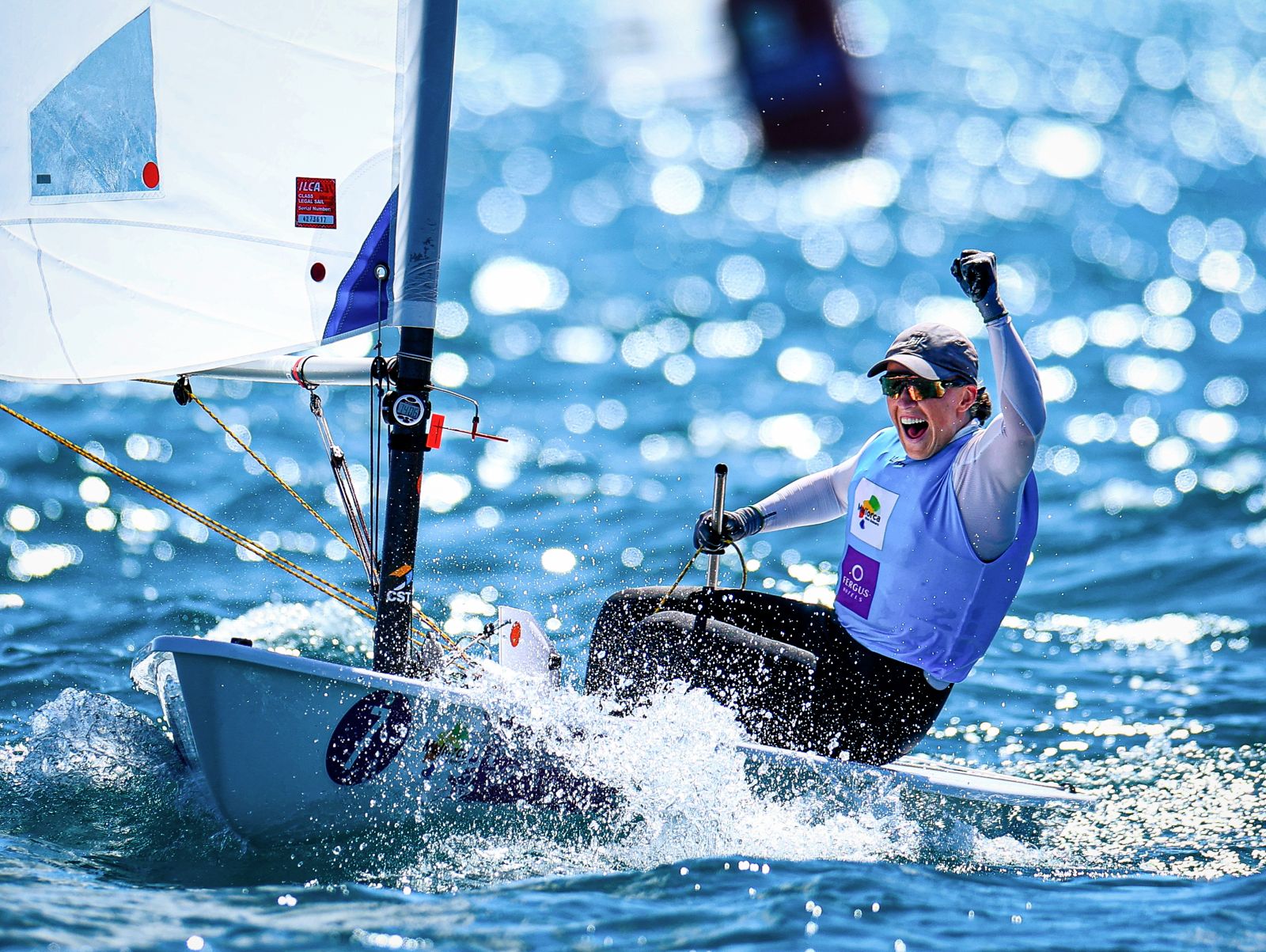
The single biggest story of 2025 was what happened in the women’s fleet.
At the ILCA 4 Nationals, female participation reached 50 percent, up from 40 percent in 2024. Two of the top three overall finishers were female. Across the full season rankings, female sailors made up 43 percent of the fleet, up from 38.
At the ILCA 6 Nationals, female participation jumped from 16 percent to 27 percent in a single year. The overall Champion of the fleet was female. Three of the top five overall were female. Across the season, female participation in the ILCA 6 rankings climbed from 19 to 23 percent.
Every host club at every Championship in 2025 provided dedicated prizes for female competitors. The TY scholarship to Valencia, worth 2,500 euro and awarded on attitude and potential rather than results, went to one female and one male sailor, both from regional development clubs.
And in December, ILCA Ireland trained and entered Ireland’s first ever team at the ILCA 4 European Team Racing Championships in Athens – a mixed-gender squad of two boys and two girls, selected on judgement as much as rankings. The class had never fielded a team in the event before. In 2025, it did.
The Sprint Series: keeping sailors in the boat
In 2025 we continued to support the expanding series of one-day events across clubs in Cork and Dublin, designed to give sailors a low-barrier, fast-paced way to race without the commitment of a full weekend regional.
Casual sailors who would otherwise have drifted away are staying connected with the fleet. Returning Masters sailors used the sprints as a route back. Competitive sailors used them as feeders into the major championships. Across the season, the impact showed up directly in the rankings: more sailors competing in more events, rather than the old pattern of single-event attendance.
Investing in the next generation, and the one after that
Every class in Ireland fights to keep sailors between 18 and 30. ILCA Ireland continues to make entry to every event free for that age group. We’re delighted to see that entries from that age category continue to grow across the ILCA 7 fleet in particular.
In the ILCA 4 youth fleet, a new Silver fleet at every event gave less competitive sailors a meaningful start line of their own, encouraging participation rather than rewarding only those at the front. In the ILCA 6 transition fleet, the funded Sailcoach TY Scholarships sent two sailors to Valencia for a month of full-time training, worth 2,500 euro each.
Behind all of it, six smaller clubs across the country received funded coaching clinics from the class. Online training sessions on fitness, Rule 42, and pre-season readiness ran throughout the year, free to members. And the class gave its regional fleets direct access to Ireland’s elite Olympic sailors through live Q&A sessions, breaking down the wall between the top of the pyramid and the clubs feeding into it.
A class that talks to its sailors
A class is only as strong as the conversation it keeps going with its members. In 2025, ILCA Ireland sent more than 20 newsletters to 850 ILCA sailors across the season, grew its Instagram following past 2,000, and ran a website and communications operation that kept every fleet in the loop on entries, results, training, and travel.
Every event across the season was officiated by a National Juror. Every sailor on every start line, from the Ulsters in spring to the Masters Nationals in autumn, got the same standard of racing.
The year in numbers
- 219 ranked sailors across the three rigs, up 46 year on year
- 130 boats at the 50th National Championships
- 47 sailors at the Masters Nationals
- 9 Sprint Series events between Cork and Dublin
- 6 smaller clubs supported with funded coaching clinics
- 29 sailors through the Road to the Nationals clinic
- 5,000 euro invested in TY scholarships to Valencia
- 20+ newsletters to 850 sailors
- 1st ever Irish team at the ILCA 4 European Team Racing Championships
- +10 points female participation at ILCA 4 Nationals
- +11 points female participation at ILCA 6 Nationals
- 1 female National Champion (ILCA 6), 3 of the top 5 overall female
Looking ahead
The 2026 calendar is already taking place, with the Ulsters, Leinsters, Munsters, End of Season, Masters Nationals, and the National Championships all accepting entries, and the Sprint Series returning with an expanded footprint. The work on female participation continues. So is the 18 to 30 free entry policy. So is the coaching clinics in smaller clubs.
2025 set a new bar. The job now is to clear it again.